
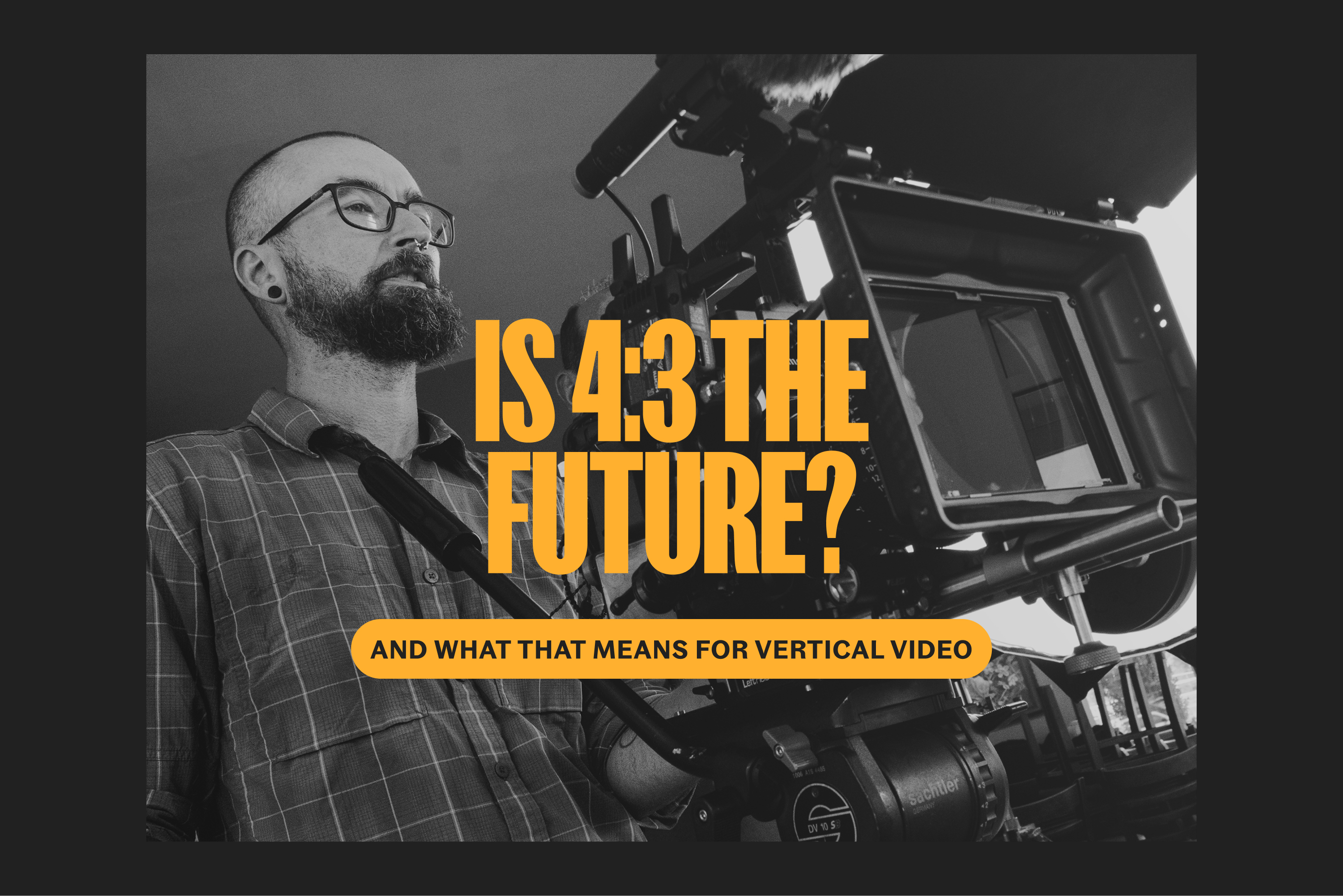
Is the Future of Social Media and Video Content 4:3?

Spread the word. ❤️🔥
C’mon. I know you want to subscribe to our Email List.
Or Follow us on X and Facebook.
Is the Future of Social Media and Video Content 4:3?
I recently debated a simple-sounding question with a creative director: what’s the best format for video?
Coming from a social media background, I felt the answer was obvious. Vertical. It’s what most people prefer when it comes to consuming content, and on social it’s been that way for years. Video in feeds went from wide to square, square to portrait, and portrait to full-screen vertical — a natural progression.
TikTok lit the fuse. Its explosion pushed every other platform toward an algorithmic, full-screen feed, mostly out of fear of losing screen time to it. And to me, that only made the case stronger. If the algorithm rewards vertical video, it’s because that’s how people want to (or do) watch. And if that’s how people want to watch, it’s the best format—for a social media marketer, at least.
Underneath all the user behavior and platform talk was the simplest argument: “it’s just because of our phones, vertical is the path of least resistance”. It’s the device we spend more time with than any other, and we hold it upright. The dominance of vertical video was basically pre-ordained. A byproduct of the hardware.
And his position? Well, it was that of the artist’s perspective — “4:3 is the best format, just look at film.”
Just a few weeks after that conversation — thanks to Apple— his argument should perhaps no longer be limited to (in my mind) that of the artist, or the creator, or the nostalgic child of the ’80s and ’90s. But instead, it should be adopted by the marketer.
So, why should the aspect ratio of the past–the same one that was the shape of the TV some of us grew up with and the old family camcorder–be what we pursue in marketing?
Because it’s having a moment. And for the first time in 20 years, the hardware in our pockets is starting to lean its way.
The Box is Back
4:3 content is mostly showing up in two places.
On Instagram, it appears in the feed and in Reels as horizontal video that doesn’t try to fill the screen. It sits in the middle of the display with room around it or nestled into the post UI. On YouTube, it shows up in long-form vlogs, music videos, and short films that pick the boxy frame on purpose even though 16:9 is the default.
The creators I see using it most often tend to fall into a handful of groups:
- Photographers and filmmakers who think in frames, not feeds. Many shoot film, in 4:3 on DSLRs, or on an iPhone.
- Fashion and lifestyle creators building a curated, editorial look, the kind of account that feels like a magazine instead of a livestream.
- Skate, music, and subculture creators, where 4:3 comes straight from the VX1000, MiniDV, and early-2000s music video look.
- Travel and lifestyle vloggers, whose content is about atmosphere and pace more than performance and tip-sharing.
They’re choosing the format for what it says, not for the algorithm.
Why the Box Feels Better
Some of it is nostalgia, but not all of it.
The nostalgia is real. For millennials, 4:3 is the shape of Saturday morning cartoons, home movies, and the family computer. For Gen Z, it’s a borrowed memory. It’s the reason there’s a thriving resale market for 2000s point-and-shoots and the reason apps like Dazz and Huji exist. The boxy frame reads as analog, personal, and a bit handmade, which is the opposite of the edge-to-edge, algorithm-first look that dominates most feeds.
It’s a portrait frame. Film has known this for a century. The Academy ratio (1.37:1) is where cinema started, and filmmakers keep returning to boxy frames when they want intimacy. Wes Anderson used it for the 1930s sections of The Grand Budapest Hotel. Robert Eggers went almost square (1.19:1) for The Lighthouse. Zack Snyder released his cut of Justice League in 4:3. A boxier frame gives more space to the human figure and less to the scenery, so the subject fills the frame, and the viewer’s attention stays with them.
It signals taste. A few years ago, a corner of the internet started calling posts that read as high-quality and high-effort as “Instagram Premium”. While this wasn’t applicable only to 4:3 video content, it became a signal that people were welcoming a break from lo-fi, low-effort, and (during this time) slop. I’d say that still holds true, and the logic makes sense when applied to 4:3. A video that fills your phone is asking for your attention. A 4:3 video with a border around it, like a picture hung on a wall, is asking you to look at it. It belongs to a wider pushback against vertical-only feeds, the same impulse (and novelty) behind Instagram’s “thinnest video” trend.
And it’s the shape the camera actually captures. This is the point most people miss. Smartphone camera sensors are natively 4:3. Every standard photo your iPhone takes is 4:3. The 16:9 horizontal video and the 9:16 Reel are both crops, cutting pixels off the top and bottom or off the sides to fit a screen. So 4:3 isn’t a retro filter. It’s the whole picture.
Hollywood Proved It, Again
If you want to see how much people care about aspect ratio, look at this summer’s biggest film conversation.
Christopher Nolan’s The Odyssey, released July 17, was shot entirely on IMAX film cameras. That meant it was shown in a spread of formats: 1.43:1 in IMAX 70mm, 1.90:1 in digital IMAX, 2.20:1 in 70mm and 2.39:1 in standard 35mm. The internet responded the way it does now, with memes and side-by-side comparison posts showing the same shot in each ratio, the tall IMAX frame towering over the letterboxed versions.
The IMAX 1.43 frame shows about a third more picture than the 1.90 digital IMAX version. The comparisons went viral because people could see what they’d be missing, and seeing it in the 70mm IMAX experience was, in short, the prestige way to watch.
A funny aside: the home release, scheduled for November, is reportedly 16:9. So the version most people will watch on a TV or phone is a crop of the one everyone was arguing about, and it makes the limited and exclusive experience of 70mm all the more special.
That’s the whole story in one film. Audiences are more aware of aspect ratio than they’ve ever been, and they’re treating the boxier frame as the premium experience.
The Hardware is Bending (or Folding) Toward the Box
For 15 years, phone screens got taller and narrower, and content followed. That’s starting to change with the introduction of the foldable phones.
First, Samsung. The Galaxy Z Fold 8, announced July 22, moved its 7.6-inch inner display to a 4:3 aspect ratio, a wider, passport-like shape that breaks from the tall, narrow foldables before it. Samsung’s Jay Kim, EVP and Head of the CX Office, called it “the new standard for viewing content,” and pointed to the way people actually use their phones: scrolling Reels and TikToks, reading and watching.
Then Apple. The iPhone Duo, Apple’s first foldable, was announced September 9. It has a 7.6-inch inner display and a 5.4-inch outer one, and Apple says both share the same aspect ratio so content carries over seamlessly between folded and unfolded. Unfolded, it’s been compared to an iPad mini, a device that’s been 4:3-ish its whole life. It starts at $1,999 and ships October 23, another premium.
Now do the math on how content fills these screens:
- On a standard phone held vertically, a 4:3 video fills about 42% of the screen. A 9:16 Reel fills all of it.
- On a 4:3 foldable display, a 4:3 video fills 100% of the screen. A 16:9 video fills about 75%. A 9:16 Reel held upright fills only about 56%, with bars on both sides.
Put simply, the letterboxing that makes 4:3 look out of place on today’s phones moves to vertical video on tomorrow’s. The format that “wastes” space now is the one that fits perfectly on the new screens.
Instagram is already moving in the same direction. In early 2025, it changed the profile grid from squares to 3:4 rectangles, and a few months later it started accepting 3:4 uploads without cropping. That’s the same boxy shape turned on its side, and it matches what the camera captures.
How You Can Make 4:3 Today: Open Gate
Then there’s the production side.
“Open gate” is a term from cinema cameras. It means recording the entire sensor instead of a cropped 16:9 portion. On cinema rigs, it’s been a pro feature for years. With the iPhone 17 Pro, it came to the phone.
Using Apple’s Final Cut Camera app or the Blackmagic Cam, the iPhone 17 Pro can record open gate video in ProRes RAW at 4224 × 3024. That’s the full 4:3 sensor, in Apple Log 2 for serious color grading. Filmmakers were pushing it further within weeks of launch, and a growing group of third-party apps, like OpenCam, offers similar access.
To be clear, it isn’t a one-tap feature in the regular Camera app. The files are huge, you’ll usually record to an external SSD over USB-C, and it’s aimed at people who already think like filmmakers. But in two years, open gate went from a feature of cameras costing tens of thousands of dollars to something a creator can do with a phone and a pocket drive.
And the most important thing about open gate isn’t that it gives you 4:3. It’s that it gives you every ratio.
The Case Against 4:3
To be fair, here’s what cuts against the trend.
9:16 still wins on reach. Reels, TikTok, and Shorts are built for full-screen vertical video. A 4:3 video on a standard phone leaves more than half the screen empty, and on platforms that reward watch time and immersion, that can hurt retention. The “premium” look has a cost in performance, and most brands can’t ignore it.
Foldables are still a niche. The Z Fold 8 starts at $1,899 and the iPhone Duo at $1,999. Foldables are a small slice of the phone market, and even with Apple joining in, most people will be watching on regular slab phones for years. Designing for a device your audience doesn’t own yet is a bet, not a plan.
Paid social doesn’t use 4:3. Meta’s ad placements are built around 9:16, 4:5 and 1:1. For now, 4:3 is an organic, brand-building choice, not a performance format.
Once everyone does it, it stops standing out. Much of 4:3’s appeal is that it signals taste. If every brand adopts it next quarter, it loses that meaning. Filters, grain and borders have all gone through this cycle.
The real answer may be “no ratio at all.” With open gate capture and AI reframing tools improving fast, aspect ratio is turning into a choice you make after the shoot. Shoot the whole sensor and deliver whatever each screen needs.
So, is the Future 4:3?
Yes, just not in the way the question suggests.
4:3 won’t replace vertical video. 9:16 is too deeply built into how platforms deliver and reward content. But 4:3 is becoming three things at once:
- The master format. It’s what the sensor records and what open gate captures, and every other ratio is cut from it. The future of production is shooting 4:3 and delivering everything.
- The native shape of the next screens. As foldables go mainstream, 4:3 stops being the ratio that wastes space and becomes the one that fits.
- A creative choice that means something. In a feed full of edge-to-edge vertical video, a boxy frame tells people to slow down and look. It’s a small provocation, and it works.
The future isn’t one aspect ratio. It’s not committing to one too early.
What This Means for Brands
If you’re making content in 2026, here’s how we’d approach it:
- Capture wide, deliver narrow. Where production allows, shoot open gate or the full sensor. One shoot can deliver 9:16 Reels, 4:5 feed posts, 16:9 YouTube, and 4:3 hero content without reshooting. That’s the most practical efficiency in this whole trend.
- Use 4:3 where the goal is brand, not reach. Hero films, brand manifestos, destination storytelling, and craft and product pieces are the places where “look at this” beats “don’t scroll past.” Travel and tourism brands especially: landscapes with people in them are exactly what the boxy frame does best.
- Keep 9:16 as your performance workhorse. Paid social and most short-form distribution still belong to vertical. Don’t give up reach for looks.
- Frame for the center. If you’ll crop one master to several ratios, keep the key action and any text in the middle of the frame. Composition is now a distribution strategy.
- Test for the foldable now. Preview your content on a 4:3 screen, or at least a tablet. Check how your vertical assets look with bars on both sides. By the time foldables are common, you’ll already know.
The screen is changing shape again. The brands that come out ahead won’t be the ones that guessed the right ratio. They’ll be the ones that shot the whole picture.

