
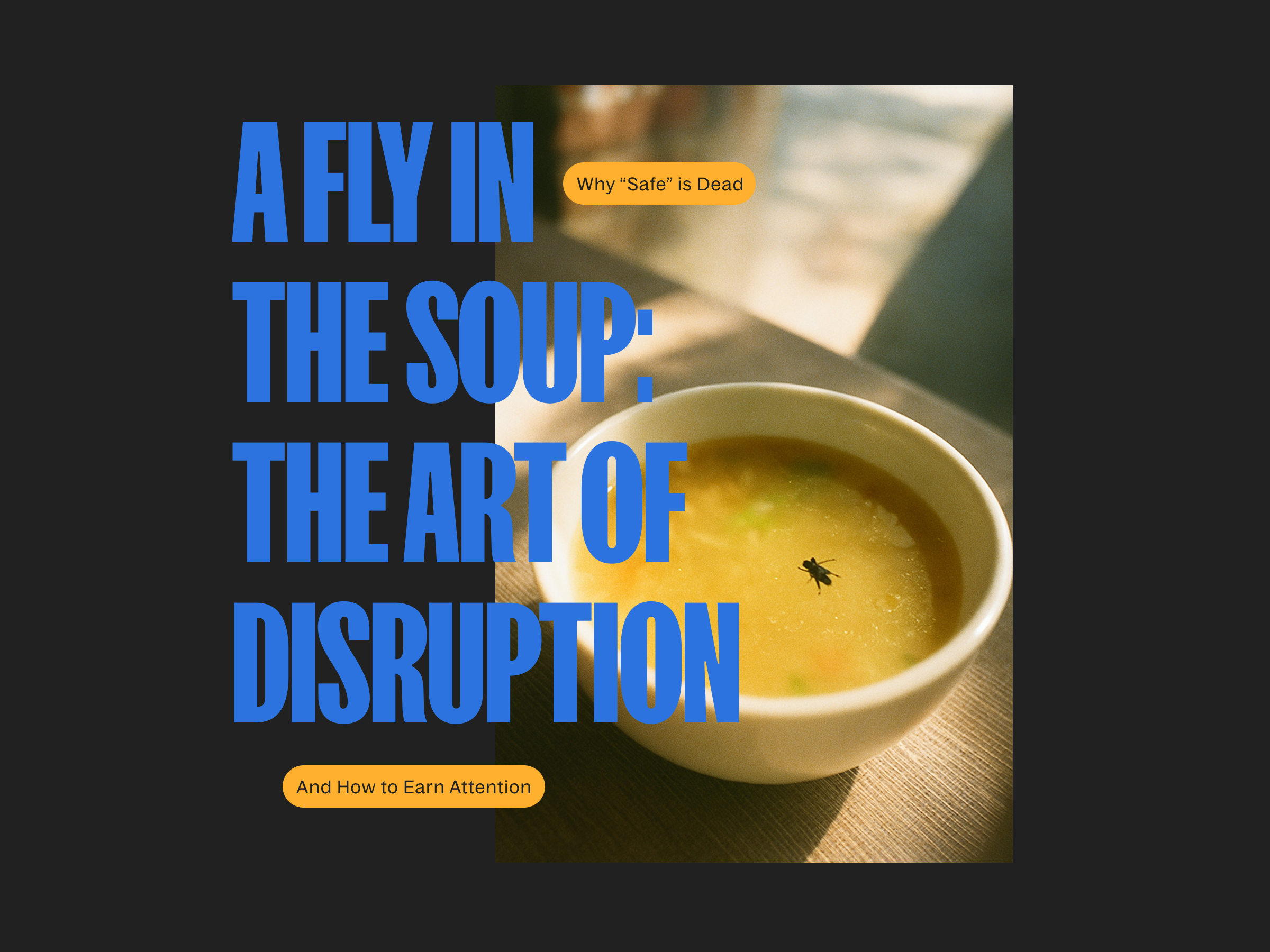
A Fly in the Soup: The Art of Disruption

Spread the word. ❤️🔥
C’mon. I know you want to subscribe to our Email List.
Or Follow us on X and Facebook.
A Fly in the Soup: The Art of Disruption
There’s something so wonderfully disruptive about the age-old idiom “a fly in the soup.”
Why? It’s not just simply because the meal is ruined. No… It’s the story. It’s the moment. And while every other bowl vanishes in conformity, our soup makes a scene. In a world of polished perfection, it reminds us that something unexpected can still happen.
Brands, take note. Conflict isn’t a catastrophe. It’s the beginning of a story.
These days, audiences are not seeking polish. We don’t care about purpose. Give us presence.
In an age of overstimulated scrolling, attention isn’t just a commodity—it’s the whole damn economy. Being seen, remembered, talked about… that’s the mission. That’s the quest.
Because here’s the truth: your audience owes you nothing. No loyalty. No eyeballs. No clicks. If your message doesn’t arrest their dopamine-depleted brains in under two seconds, it doesn’t matter how noble your purpose is or how sustainable your packaging may be.
We live in the golden age of distraction. TikTok chefs pull more viewers than broadcast networks. Cartoon mascots trend harder than Oscar winners. And somewhere, a man livestreaming clipping his toenails has a bigger audience than the entirety of your last campaign.
To be ignored is the default. To be memorable is divine.
To truly ascend—to become what we’ll call a branding god—you have to be more than visible. You have to be irresistible.
But most gods are boring.
The God of Strategy, a rigid deity, all metrics and no mood. The Goddess of Synergy, humming softly in corporate sans serif. The Sacred Duo of Budget Spreadsheet and ROI, whispering from behind the legal table. A divine yawn.
Keep your day job, Odin. Nobody gives eye contact to Hermes. I don’t want to be Apollo. I want to be Loki.
The trickster. The chaos agent. The one who tosses the fly into the soup, then waits to see who screams and who laughs. Because that, dear reader, is what gets remembered. That’s what gets shared.
Everything Is Entertainment
In 1985, ABC, CBS, and NBC had a 70% share of TV viewership. Today, that’s barely 30%. The top MrBeast video makes SNL look like a high school talent show. A Duolingo owl flirts with Dua Lipa on TikTok and hijacks Super Bowl conversations.
This isn’t about being “fun.” It’s about being entertaining. There’s a difference.
A fun brand might drop a meme now and then. But… An entertaining brand creates culture. It shows up as a character, builds worlds, tells stories that ripple outward across platforms and group chats.
The data backs this up. According to the Entertainment Index, the top 30 most entertaining brands on earth aren’t just viral—they’re profitable. 67% reported double-digit growth. Nearly all of them saw revenue increases. Not because they’re “cool,” not because they “caught a trendy vibe” … but because they understood something most brands have forgotten:
There are no categories anymore. No industry lines. Just the great screaming maw of culture devouring content 24/7. And brands? They’re snacks.
Most of you are in denial. You think you’re building brands. You’re not. You’re auditioning. In a multi-billion-dollar talent show with a million distracted judges. And they swipe with impunity.
Characters Win, Campaigns Die
Forget “brand consistency.” Let’s talk Brand Lore.
Duolingo doesn’t have a brand. It has a sentient, slightly unhinged owl with a TikTok problem. Liquid Death sells canned water… Canned water! But, by the gods, these storytellers have become the face of disruptive, entertaining marketing.
Characters. Narratives. Universes. Not logos. But… mythologies.
Every touchpoint is another page in the story. Every merch drop, another prop in the play. Every comment section, another line of dialogue in an ongoing improv performance.
And these stories don’t require love. They require attention. The data showed that the top brands didn’t even score highest in trust or memory. They scored in humor, social shareability, shock, and character.
In other words: Stop trying to be liked. Start being watched.
Hire the Freaks, Find the Fire
You can’t create this kind of fire with stock assets and a whiteboard.
To be entertaining, you need un-standard talent. Bartenders. Dungeon Masters. People who juggle for fun. YouTubers. Failed comedians (this one hits close to home lol!). Creatives who’ve lived inside the feedback loop of an audience’s attention, not just watched a webinar about it.
And increasingly, brands are letting them lead. Doritos gave the Super Bowl keys to a couple of unknown content creators and got one of the best-performing chip ads in seven years. Duolingo’s TikTok reign was architected by a fresh-out-of-college Gen Z’er who turned a green owl into a national icon.
Entertainment doesn’t start with strategy. It starts with guts.
The Gospel of In-House Hollywood
And now, the good news.
Some of us have seen the light. And we’re building churches—not for conversion, but for creation. We call it: In-House Hollywood.
Designsensory doesn’t have departments. We have writers’ rooms. Our briefs don’t read like project charters. They read like pilots. Series arcs. Plot twists. Our productions don’t feel like ads—they feel like episodes. Like sketch comedy. Like something you’d actually watch on purpose.
We don’t pitch “deliverables.” We preach the gospel of earned attention.
The brands that embrace this model are the ones turning marketing from background noise into bingeable narratives. They’re not buying space in culture. They’re making it. Owning it. Becoming it.
Because when you treat every campaign like a cold open, every product like a prop, and every post like a punchline—the audience comes back. They subscribe. They share the sermon.
So yes, be the fly in the soup, the pickle in the punchbowl, the sock in the salad. Be the thing people remember, even if it unsettles the palate. Be weird. Be risky. Be wildly, wonderfully entertaining.
Because in this pantheon of branding gods, safe is dead. And the trickster is king.

