
 Culture ❤️
Safety on Set: Returning to Production in the Age of COVID-19
Spread the word. ❤️🔥
C’mon. I know you want to subscribe to our Email List.
Or Follow us on X and Facebook.
Safety on Set: Returning to Production in the Age of COVID-19
If you’re anything like us, your year thus far has been full of questions. No corner of life has been spared from inspection, review and — let’s be honest — at least a small dose of uncertainty. Whether it’s evaluating if the vacation plans you made months ago are still valid or safe, determining if sending your children back to school is right for your family, or even just deciding how many masks you need to get through the week, every day seems to be full of an unprecedented number of questions.
It can all be a little exhausting. But, arguably, it would also appear that this current reality is forcing us to be extraordinarily present.
For the team at Designsensory, being present has meant a whole lot more than just keeping up with refilling our hand sanitizers! In particular, it’s meant taking stock of three key indicators:
- The need for content: Crafting the right conversations with your customers to educate and inform, as well as maintain engagement
- The demand for content: Answering the call of households across the country to replace activities that have otherwise been paused, as well as maintain a connection to the outside world
- The role of content in our economy: Continuing to support and employ the tens of thousands of citizens — and their hundreds of millions of dollars in economic output — that rely on the production industry
Alongside our financial responsibility to our clients, we all have a responsibility to our colleagues and communities to stay safe and minimize risk, which brings me back to the concept of “questions.” As part of our work servicing the State of Tennessee, our agency was deemed “essential” as early as mid-March, with production services continuing in an adapted, but uninterrupted format ever since.
Over the last six months, we’ve worked with respected institutions like the Centers for Disease Control and Motion Picture Association to develop a rubric to determine the format and production envelope that is most appropriate for your situation. These guidelines have not only provided consistent evaluating criteria for assessing our work, they have also served as a daily touchstone to determine if we need to adjust our strategy or approach.
Question 1: In order to create your “safe” set, is a set even really necessary?
Although answering this question will likely touch on the topics of budget, timeline, audience, message and usage, at the heart of it is the understanding that “further is safer.”
For the team at Designsensory, this meant plotting all of our production options along a spectrum from contactless to conventional. These options include:
-
Animation: Our work with the Tennessee Office of the Governor required that we unpack extensive and sometimes confusing guidelines for everything from applying for the Paycheck Protection Program to equipping gyms, salons, and restaurants with best practices for reopening their businesses. Furthermore, these projects required the content be fully developed, designed and delivered within 48-72 hours. Videos featuring animated text and illustrations provided a solution that could be executed quickly in-house, even while staff were working from home. They also provided a shareable, digestible means of communicating complex recommendations and restrictions.
-
Sourced and Archival Material: In an age of increasing customization, it can be easy to quickly dismiss the value of “stock material.” However, in the case of clients like the Gatlinburg Convention and Visitors Bureau, footage from past shoots provided easily accessible imagery that capitalized on the timeless, iconic attractions they have to offer, while also providing the viewer with an opportunity to escape momentarily to a happier time. Furthermore, “sourced” doesn’t necessarily mean “stock.” For clients like Memphis-based Old Dominick Distillery, sharing free product with influencers embedded within target markets resulted in custom, original content. At the same time, this content benefited from the organic discovery of each influencer’s niche following in lieu of typical budgets for paid and boosted media. In the case of Zoo Knoxville, a call to action via social channels for fans to share photos and videos from past trips engaged the audience, activated their nostalgia, and quickly generated a robust repository of material.
Question 2: Can you start small?
For some clients, unprecedented times mean unprecedented content. Reflecting a new reality may mean that capturing highly specific footage is simply unavoidable.
For the team at Designsensory, this need drives us further down the spectrum, including:
-
Studio Productions: We may not be able to go out or travel as much as we’d like, but luckily the magic of e-commerce allows us to bring some of our favorite brands to us instead. With clients such as Old Dominick Distillery and Biltmore, launching new product lines required product photography, both for marketing and promotional purposes. Utilizing our in-house photography studio, a crew consisting of an art director, photographer, and digital imaging technician we were able to divide and conquer, maintaining distancing while setting up equipment, styling, and managing media.
-
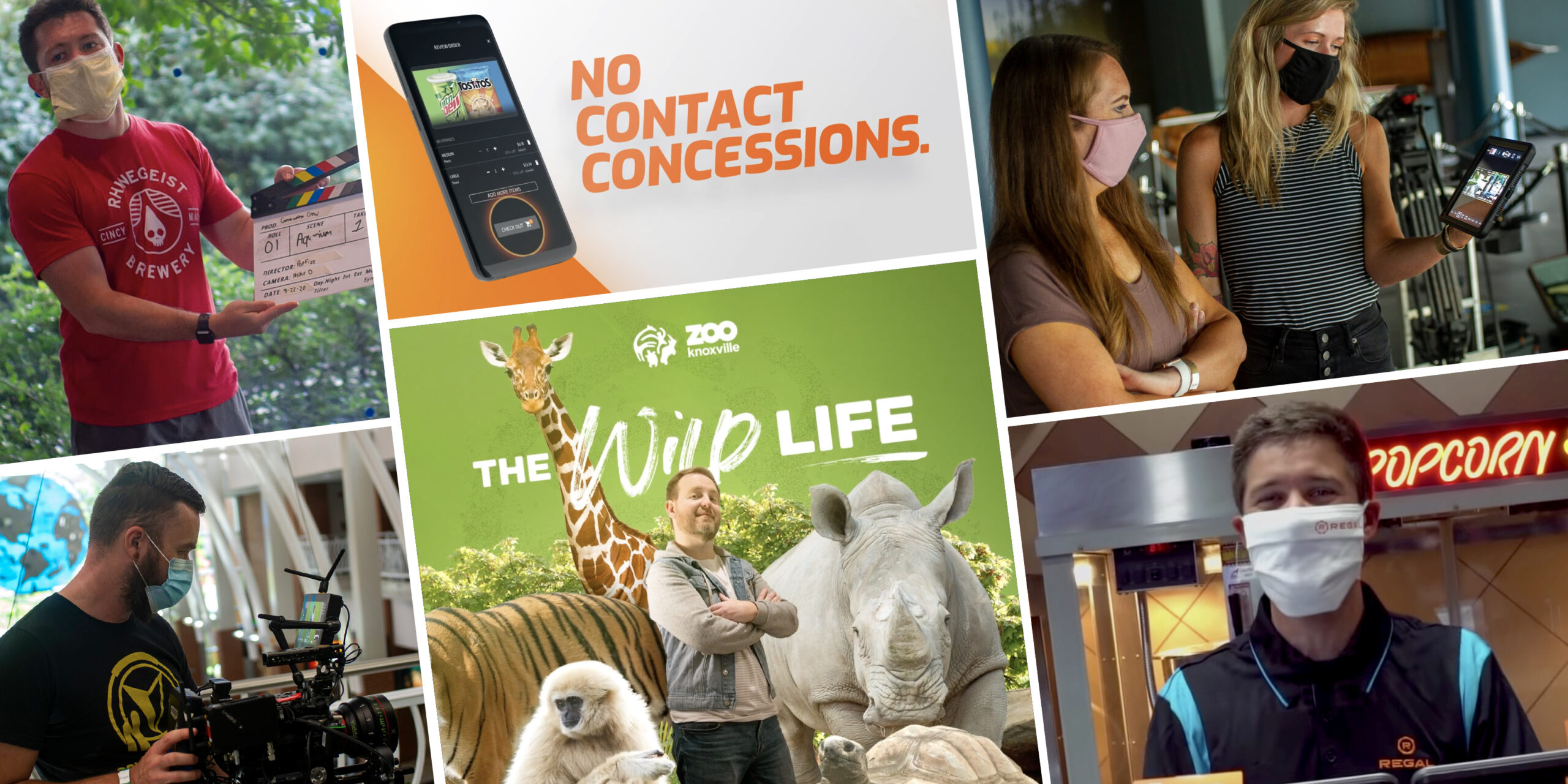
Small-footprint Productions: For clients like Regal Cinemas, making guests comfortable in coming back meant implementing extensive procedures and guidelines within their locations. Original capture was the only option that made sense to showcase these policies in practice, but a condensed production envelope consisting of a director, a camera operator with a long lens and on-screen talent were sufficient to tell this story visually. For clients like Zoo Knoxville, however, content not only provides a means of staying connected to your audience during a time of reduced capacity, it also creates opportunities for connections with educators, either professional or temporary, who are suddenly confronted with the challenges of at-home or virtual learning environments. In this instance, a mid-form episodic digital series called “The Wild Life” allowed Zoo Knoxville to showcase their animals, as well as their staff’s work behind the scenes, all while educating and entertaining. Given the nature of on-the-fly unscripted content, two cameras and an audio operator were necessary to ensure no magical moment was missed.
Question 3: Can you accommodate COVID-safe procedures?
Where scripted content is concerned, crews can often only be optimized to a point, with departments like wardrobe, hair and makeup, and art being integral to telling the correct visual story.
In these instances, the team at Designsensory believes achieving safe sets can be accomplished in the script, as well as the situation:
-
Formulating narrative solutions: In many instances, taking a creative pass through your script will identify opportunities where small adjustments allow for characters to be distanced and/or separated. Often, these choices also impact the crew and departments involved behind the scenes, as they may be styling, directing, lighting, etc. fewer characters at once. After pushing the filming of a longform children’s pilot for the Tennessee Aquarium, our executive producers and screenwriter went back to the writer’s room to identify conversations in the script that could be accomplished via video conferencing. The adjustments not only meant fewer folks in a space at one time, they also increased the content’s sense of timeliness and authenticity
-
Orchestrating a safe set: In an effort to set sterling standards for safety, it’s important to integrate the intention of policies like distancing and sanitization within every layer. Start by limiting the size of each department, then scheduling work to leapfrog departments as often as possible. For instance, sending a camera team into a location to establish a frame and then activating Grip and Electric means the teams never have to be in the same space. Next, when choosing your location for filming or base camp, look for a space that allows teams to occupy separate rooms (i.e. one holding room for talent, another for HMU, another for art, etc.). Within each room, take the time to lay down tape marks or decals and hang signage to guide the occupants on how to maintain distancing while in the space. Obviously avoiding the possibility of introducing the virus to the crew is ideal so, if the budget allows, consider contracting a service to provide quick-turn testing for the cast and crew 24 hours before principal cinematography begins. Past this, designate a Sanitization Officer on the crew tasked with checking in cast and crew members each day, along with performing a temperature and symptom check. For multi-day productions, consider using a different color of disposable bracelet each day to clearly indicate who has and has not gone through this process. Aside from outfitting each space with sanitizing supplies, equip your production staff with appropriate sanitizers to wipe down high-touch surfaces regularly. Mandating that masks be worn by crew at all times, and the cast anytime they aren’t actively filming, adds yet another layer of protection — literally. Single-serve snacks, drinks, and boxed meals also eliminate an additional point of contact. Finally, if the budget allows, consider integrating certain technologies into your gear package to allow footage reviews to take place remotely. For instance, the Teradek Serv Pro system allows camera operators to easily share their feed to Apple and Android devices, as well as stream securely online for offsite audiences.
This is a developing situation; a choice made a few weeks ago may not be a good fit a few weeks later. How exactly do you come to that determination? It’s not enough to ask questions; you must ask the right questions — and ask them frequently.
Let’s face it: as creatives, we’ve made a career out of thinking outside the box. And while this pandemic may present us with unique challenges, we’re all in this together. We may not be able to come together physically right now, but we can come together collaboratively. It may mean that the only thing we get comfortable with over the coming months is being uncomfortable. But if necessity truly is the mother of invention, then our best days are still ahead of us.

